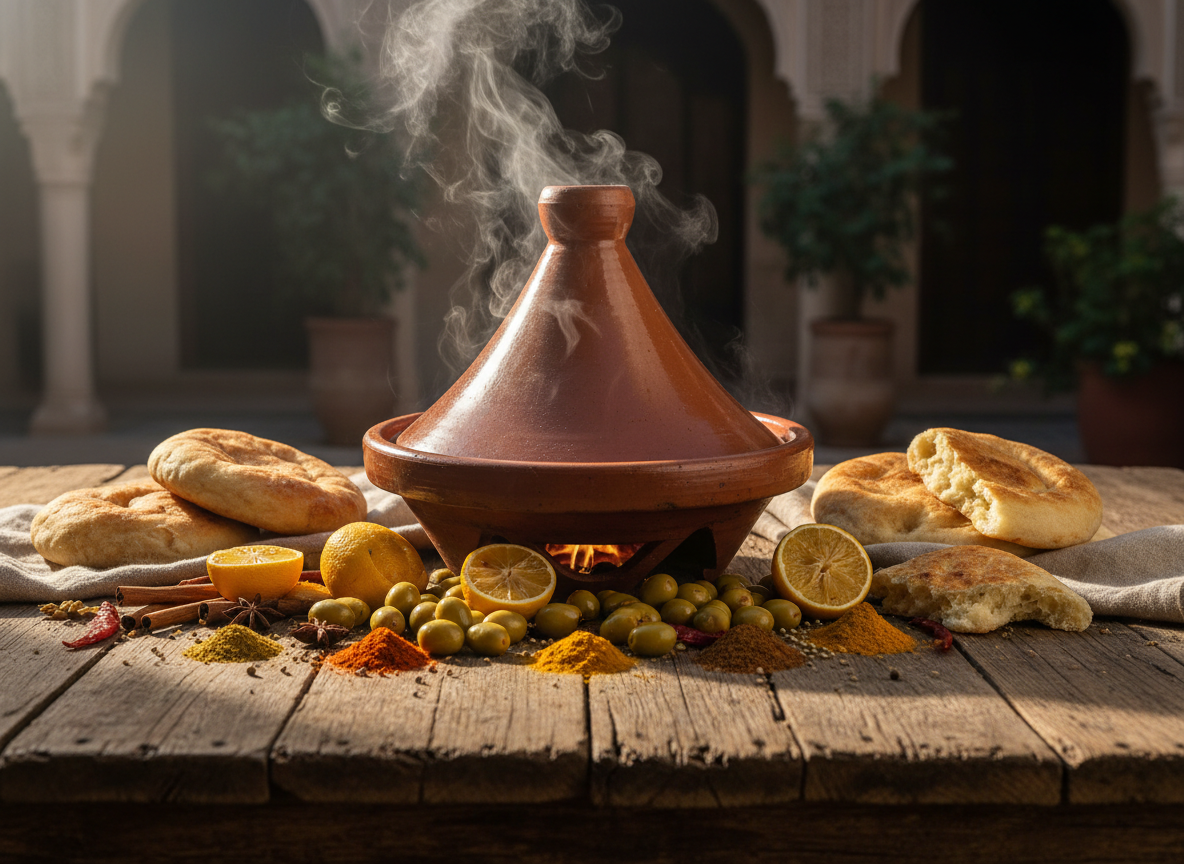
Few dishes say Morocco as clearly as the tagine. The word names both the cooking vessel, a shallow base topped with a tall cone-shaped lid, and the slow-simmered stews made inside it. Here is how it works and what to look for.
How the pot works
The clever part is the lid. Steam rises into the cone, cools and drips back onto the food, so the stew cooks gently in its own moisture and needs very little added water. Wikipedia notes that this matters in places where water is scarce, and that unglazed clay also absorbs some of the liquid. Britannica adds that the low, gentle heat turns tough cuts of meat tender.
Traditionally the pot sits over charcoal in a small clay brazier. Britannica links tagines to nomadic Berber peoples, who likely used them as portable ovens, and says ceramic versions may have been introduced by the Romans.
What goes inside
Moroccan tagines are typically stews of meat, poultry or fish with vegetables, fruit or nuts. Onions form a thick sauce in nearly all of them. Common spices include ginger, cumin, turmeric, cinnamon and saffron, and sweet-and-sour pairings such as lamb with prunes are classic. Bread is the usual accompaniment.
Britannica describes four main styles, named for their seasonings:
- M’qualli: olive oil, turmeric, saffron and ginger.
- M’hammer: butter, paprika and cumin.
- Mchermel: a chermoula marinade.
- Tomato-based: built on a tomato sauce.
Cooking with one at home
Modern cooks use a slow oven or the lowest stovetop heat, often with a heat diffuser. Both sources warn that sudden temperature changes can crack a clay pot, and some decorative tagines are not meant for cooking at all, so check before you heat one. Flameproof stoneware and cast-iron-bottomed versions are made for stovetops.
The same name travels well beyond Morocco: Wikipedia notes that a Tunisian tagine is closer to a baked quiche, while Libyan versions resemble a frittata. In Morocco, though, the tagine remains a slow, shared meal, best eaten with bread and unhurried company.
Sources: Wikipedia, Tagine; Encyclopaedia Britannica, Tagine. See also our guides to Moroccan mint tea and argan oil.



Leave a Reply