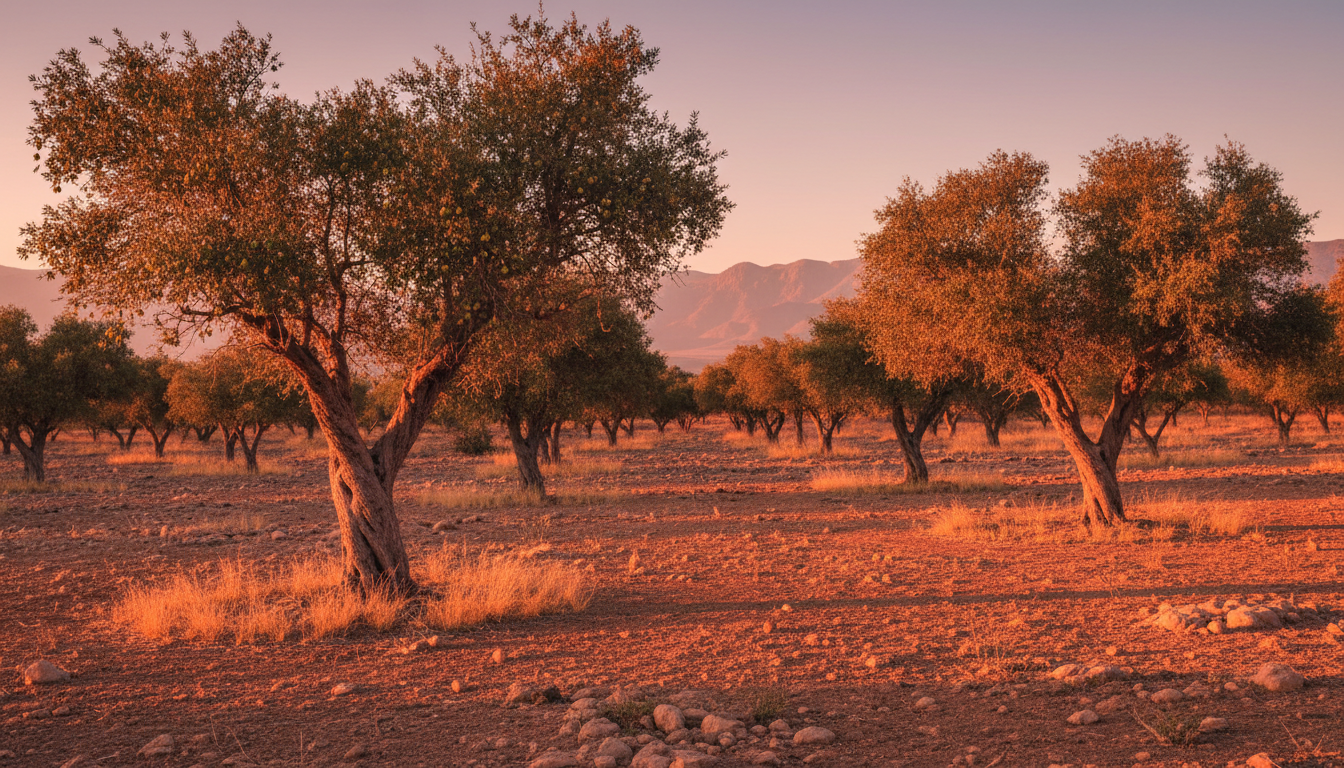
Few Moroccan products travel as far as argan oil. Pressed from the kernels of a thorny tree that grows in the country’s southwest, it ends up in kitchens, bathrooms and gift shops around the world. Behind the bottle is a slow, mostly manual process that UNESCO has recognized as a living tradition.
A tree that belongs to one corner of Morocco
The argan tree grows mainly in Morocco, with a small presence in southwestern Algeria, according to Wikipedia. Its heartland, known as the Arganeraie, lies around the Essaouira and Souss regions, and UNESCO describes the tree as an endemic woodland species of the Arganeraie Biosphere Reserve in the southwest of the country. The World Intellectual Property Organization (WIPO) says argan is Morocco’s second most common forest tree and that it provides food and income for around three million people.
From fruit to oil, by hand
The traditional method is laborious. According to UNESCO and Wikipedia, the main steps are:
- Harvesting and drying the fruit, then removing the fleshy pulp.
- Cracking the hard shell by hand to free the kernels.
- For culinary oil, gently roasting the kernels, then grinding them into a brown paste.
- Pressing or kneading the paste, with warm water added gradually, to release the oil.
Estimates of how much raw material is needed vary by source and method. WIPO cites roughly 20 kg of fruit and nearly 20 hours of labor for one liter in the traditional process, while Wikipedia gives about 40 kg of dried fruit per liter. Mechanical extraction, which is cheaper, is spreading. The leftover press cake is used as animal feed.
The women behind the bottle
UNESCO, which added argan practices to its Representative List of the Intangible Cultural Heritage of Humanity in 2014, notes that the know-how is carried mostly by rural women, known as the “argan women,” who pass it to their daughters from a young age. WIPO reports that women began forming cooperatives in the early 1990s, with roughly 50 women-run cooperatives by 2010, and that members then earned about six euros a day, far more than they made working alone. WIPO also notes that Morocco applied to register “Argane” as a protected geographical indication in the European Union in 2011, partly to help fight fakes.
Buying and visiting
WIPO warns that diluted argan oil, or olive oil colored to look like it, is sold by some roadside vendors, which hurts genuine cooperatives. Buying from a labeled cooperative is the simplest precaution. Travelers can see the process at cooperatives around Essaouira, which Royal Air Maroc plans to link with Casablanca by direct flight from November 1, as we reported earlier today.
Slow to make and tied to a single landscape, argan oil is as much a piece of cultural heritage as a commodity, and its future depends on the trees and the women who tend them.



Leave a Reply