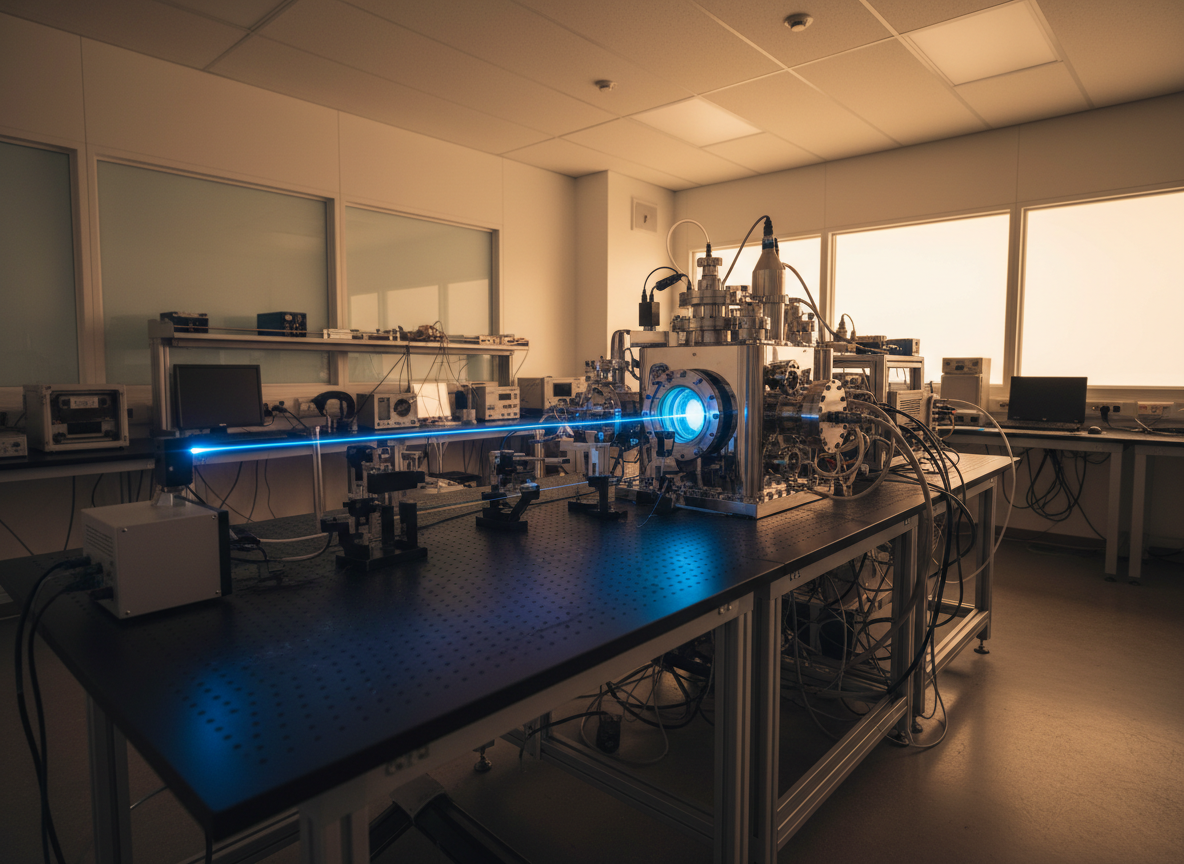
Researchers at the Max Planck Institute for the Science of Light in Germany report that single molecules sitting on a surface have, for the first time, reached the Fourier limit, the maximum quantum coherence that physics allows. The work was published in the journal Science in June 2026 and has been recirculated this month by ScienceDaily.
Why the Fourier limit matters
A quantum emitter, such as a single molecule, can only stay “quantum” for a limited time. That coherence time can never exceed a ceiling set by how fast the emitter hands its energy to its surroundings. Dirty or noisy surfaces normally cut coherence short, by factors of hundreds or even thousands, according to the institute’s release.
Reaching the ceiling therefore shows that the molecule’s environment is extremely quiet and stable.
How the team did it
The group, led by Prof. Vahid Sandoghdar with Dr. Alexey Shkarin, followed three steps:
- They placed a small organic crystal in a vacuum cryostat and let its top layers slowly sublimate at room temperature, carrying contaminants away.
- They cooled the crystal to a few kelvin above absolute zero to stop further sublimation.
- They deposited molecules onto the freshly cleaned surface using a microfabricated oven.
The researchers also found that the surface itself matters: it aligned the molecules in particular directions and shifted their energy levels, and may influence their shape or vibrations.
What comes next
Emitters like these are candidates for quantum technologies, including generating single photons, storing quantum information and distributing entanglement for quantum communication and computing. The team plans to combine the method with atomic force microscopy and scanning tunneling microscopy to control individual emitters at the nanometer scale.
The result is a laboratory milestone rather than a product, but it shows that surface-bound molecules can be as well behaved as those embedded in bulk crystals, a useful step for anyone building quantum devices.
Sources: EurekAlert (Max Planck Institute for the Science of Light release); ScienceDaily



Leave a Reply